Thursday, October 30, 2008

Week 5: Neha's Recounting

So due to a prior commitment, I did not actually make it out to the field for Week 5, having instead participated two weeks in a row and joined the second team for Week 4 (they turned out to be incredibly nice people, despite the rumours). Accordingly, my information for this post is derived mainly from Neha’s riveting recounting of events, and therefore any factual inaccuracies should be blamed on her. Or Andre. That’s fine too. Actually, that’s preferable. He can be reached at andre.costopoulos@mcgill.ca.

During Week 5 the team largely divided their attention between Grave 1 and Grave 2, with Carrie, Noam and Jen continuing to excavate Grave 1. They began by mapping the entire area, providing a detailed depiction of the possible architectural feature. In addition to the boundaries of the ‘inhumation’, they included all of the large rocks on the map, which helps us to visualize whatever it is the possible feature might be. In addition to the mapping, they decided to investigate one of the higher tumuli that is situated within the potential house structure. After digging a cross section, they didn’t find anything telling, but now we have a clear stratigraphic profile for the area of Grave 1, so the undertaking proved worthwhile. Finally, in an episode strongly reminiscent of Colin’s “Cutting a root, cutting a root, cutting a rib, cutting a root….crap” incident from Week 3, Noam got up after hours of digging and realized that he’d spent most his time at Grave 1 sitting on a mandible. In addition to providing yet another amusing Team 1 pratfall, this episode serves to illustrate one of the taphonomic anomalies that characterizes Grave 1. While there is an abundant amount of loose bone on the surface, there is almost nothing except dirt once exacavation down into the grave is begun. Accordingly, next week we’re planning on extending the grave in order to see where it goes and attempt to solve the mystery of differential surface/grave bone deposition.

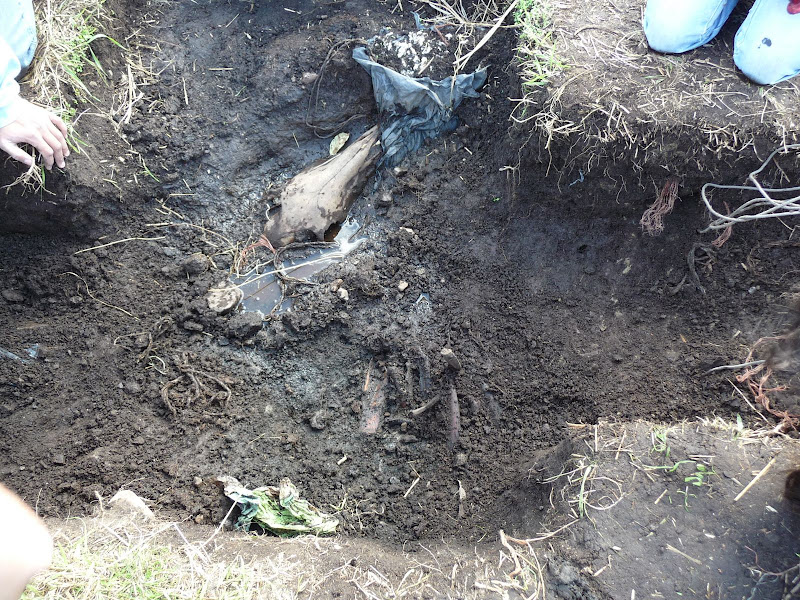
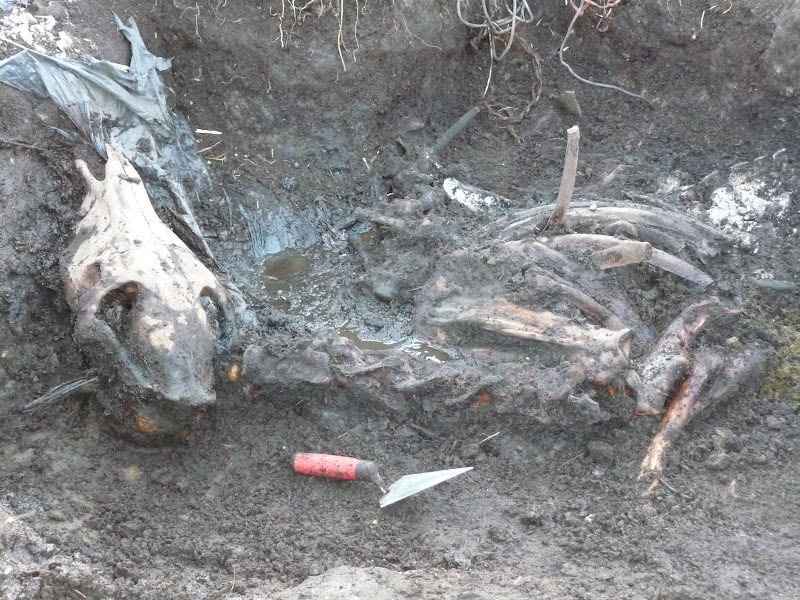
While all of this exciting mandible discovery was going on at Grave 1, the rest of the team was busy solving yet another mystery (Digression: Parc Safari would provide an excellent setting for a Scooby Doo episode), that of the “zebra” in Grave 2. Since we had uncovered more of the skull and associated ribs during Week 4, the team began to extend the pit in the direction (NW) that they thought the hind legs would be going. Instead of hind legs, a horn began to emerge. Based on the features of the attached skull, the current hypothesis is that the new skeleton is that of a ram, and, as Neha points out “Zebras have no horns”, so it’s unlikely it’s a second equid. As if an additional animal wasn’t enough, current theories also suggest that the smaller vertebrae and associated ribs in Grave 2 do not in fact belong to the zebra. The ribs are far too small for the zebra, and they’re also a mite too small for the ram, so the suggestion has been made that they belong to a fetus, though, as certain TAs reminded me, such an identification is complete speculation at this point.

Oh, and in addition to the zebra, the ram and the possible fetus, something that appears to be a partially decomposed bird in a garbage bag was also pulled out of Grave 2. This particular mass grave is starting to remind me strongly of the whole ‘clowns in the Volkswagen’ scenario. The team realized that the carcass might be avian in nature when they found feathers mixed into the abundant amount of “cream cheese” (Andre’s ‘technical term’ for the pungent adipose layer that surrounds recent burials) that surrounded the bag. As if those weren’t enough elements of decomposition to be dealing with, the team had also begun to excavate down to the level wherein the zebra skeleton was surrounded by evidence of the final expulsions of the corpse. All I can say is that I’m sorry to have missed such an excellent opportunity to experience the thrills of archaeology first hand.

Once the team had finally finished with all the extraneous animals in the pit, the focus returned to the “zebra’. Current theories suggest that the “zebra” is in fact one compact burial, with the animal’s long bones and metatarsals enclosed in its own ribcage. In addition to the discovery of the long bones, the team was enthused to find that they excavated deep enough to begin exposing the “zebra’s” mandible. Thought I was in fact enjoying wine and cheese elsewhere, I was filled with regret that I missed the satisfying sense of accomplishment that I am certain filled the hearts of every member of Team 1. Congratulations guys.

Instead of attempting to map such a tortuous anatomical mess with a line level and string, the administrative decision was made to simply photograph each stage of the excavation, with the two measuring tapes stretched across the pit acting as a proxy for coordinates and quadrants. One of the team’s final acts before heading back to Montreal was to remove the long bones and metatarsals from the ribcage and ‘bag and tag’ them, as the rising water tables in Grave 2 would have disarticulated the elements anyways after another week of exposure to Quebec’s much appreciated seasonal rains. This was followed by the pièce de resistance: the removal of the “zebra” skull. If we don’t get all of the equid bones out of the ground before temperatures drop, I am sure it will be used as some sort of Megalith stage prop. Accordingly, I await further field developments with great anticipation.


The sight we're graced with every week upon arriving at Parc Safari.


"Ok. So. If I were you I might not eat that - I think it's been in the pit"


Jen and Noam preparing to map Grave 1.


Carrie following suite.


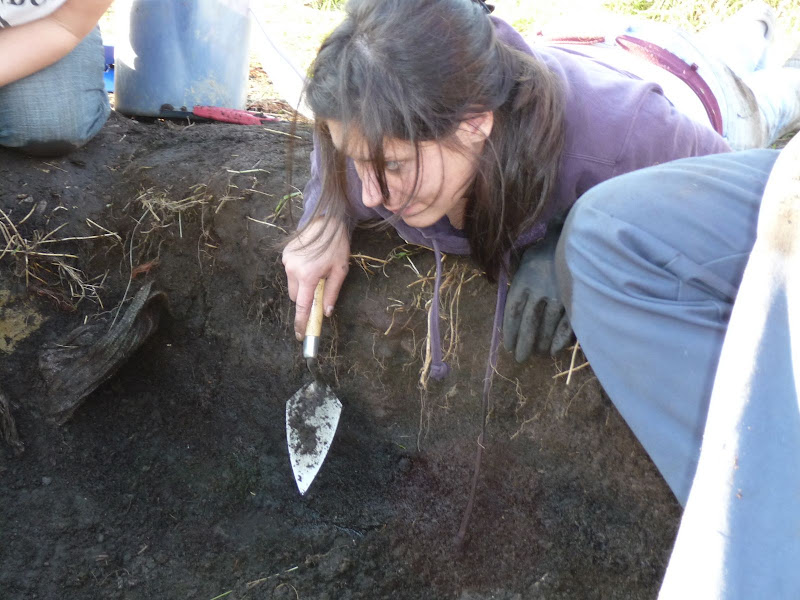
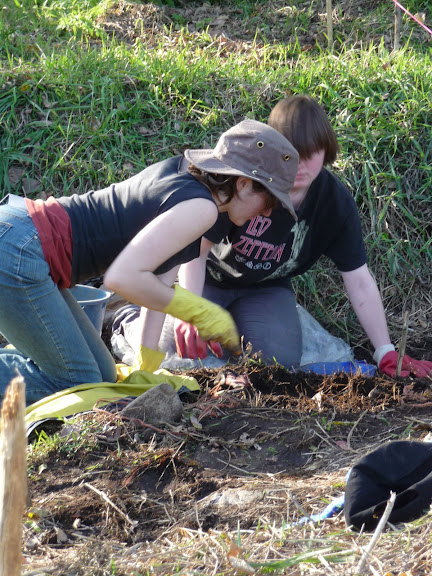
Tay and Corey trowelling away at Grave 2.


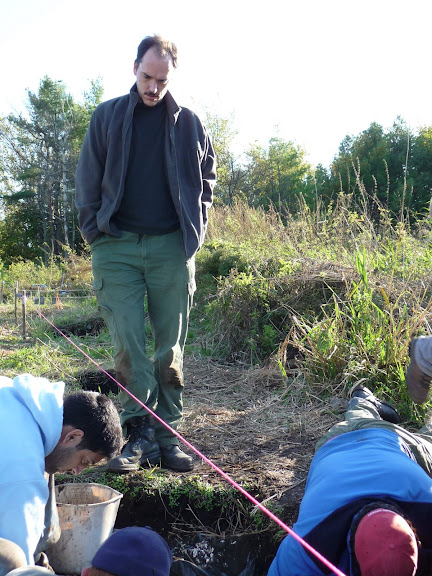
Andre, very pleased that all of his students are demonstrating their respect for him by bowing. Except Anita, who is reacting to the situation appropriately, I feel.


Grave 2 in all its majesty.


Vertebrae.


The glorious bird bag.


Notice how jumbled the bones are.


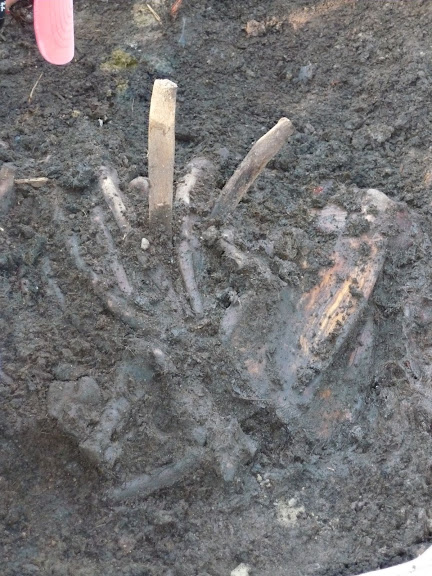
The long bones and metatarsals enclosed in the "zebra's" ribcage.


The unexpected horn.


Andre pointing at things.


Andre removing the skull using technologically advanced archaeological equipment.


"Hmmm, I wonder if there's any meat left on this thing."


The mandible - stained red from hematite or some such thing. Neha gave me a detailed explanation which I promptly forgot.


Even redder in a different light.


The tape measure "quadrant system".


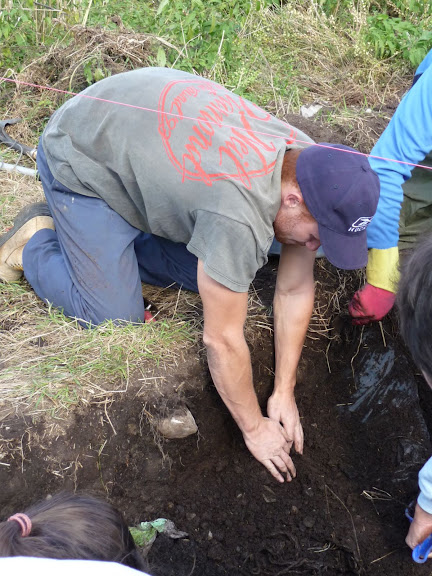
Andre poking at mud.


I call this group portrait "Everyone with dirty pants".


Andre's take on "2001: A Space Odyssey".


Collecting the "Little Bones". Bonus points if you get the Canadian music reference.


Anita was very excited about the skull.


If Anita got this excited about anything that could actually be marketed, she could have an excellent career as a salesperson.


A final view of the waterlogged pit - Grave 2.


While his students are mesmerized by the animal remains, Andre attempts to clandestinely practice his famous 'vibrating hand' trick.


Which the girls on the other side of the pit were secretly watching.

Wednesday, October 29, 2008

Week 4: Not a Giraffe and MORE intrigue!

It’s not a Giraffe. Of course you already know this because of the spoiler at the end of last week’s post, but I felt it necessary to mention this at the beginning of this post. This was determined not through further excavations of the skull, but rather by using the miracle of Google. A Google Image search led to several interesting photographs of Giraffe skulls and comparing these photos to those photos already taken of the skull found in Grave 2 it became clear that the morphology of Grave 2’s skull is significantly different than that of a Giraffe. Further Google Image searches seemed to indicate that the skull found in Grave 2 was most likely that of an equine.
So this week Alpha Group (which as you all know is Group 2) headed down in the hopes of uncovering more remains within Grave 2, hopefully leading to a full skeleton, and identifying the species of the skull and any associated remains (the two most likely choices; Zebra or Onager). Upon arriving it was fairly certain that the majority of our work would be in Grave 2. However it wouldn’t be too productive to just throw everyone into Grave 2, so Jess and Claudine (who had traded places with Alpha Group regulars Amelia and Lisa) continued to excavate Grave 1 in hopes of gaining more insight into what exactly was buried in what was becoming more and more clearly a complex burial.
The day of excavation in Grave 2 began with everyone’s favorite activity, bailing, the ever present water table once again forcing us to empty out Grave 2 which was filled to the brim with water. Grave 1, owing to the fact that it is not very deep, did not require the ritualistic bailing operation, and thus excavation there began quickly. Grave 1 at first produced some finds, mainly small loose bones, around the topsoil. And then… well after that there was what Andre described as “surprisingly nothing”. So Grave 1 is quickly turning out to be a bust.
Grave 2 was of course the center of attention this week. The discovery of the skull led to a whole bunch of questions, mainly, was there a full skeleton down there? If there was the orientation was of course still a mystery. The previous week’s excavation also uncovered some ribs and this was a possible indication of the way the remains were orientated. The main task thus was to expand the area of Grave 2. We expanded it both to the west and east. The eastern expansion failed to lead us to any other equine remains. What we did find was a garbage bag that seems to be filled with the remains of a deceased animal. The animal contained within said garbage bag was not determined. Frankly, I’m not entirely sure any of us wanted to find out what was in the bag, especially when you consider the fact that emanating from the bag was a smell that would make dung farmers wince (I do not know if dung farming is a real profession, please do not e-mail me with facts about dung farming, and if any dung farmers are reading this I apologize, I truly meant no harm). The western expansion was much more productive and did in fact expose remains which we believe belong to the equid. (Sidenote: As we expanded Grave 2 Kim was talking about dismemberment, she claimed that she had recently been watching horror movies, the rest of us on the other hand were becoming slightly concerned. This will become relevant a bit later in this post). As I said the western expansion uncovered more of the equid remains, mainly the ribcage of which a couple of ribs had already been found. With the eastern expansion a bust the excavators working there moved to the center of the pit in order to clear more area around the skull and hopefully fully expose the neck of the equid. This is where things got intriguing. Located by the skull was the neck, which was fully articulated. The neck led to the scapula, however it led to the wrong end. Instead of leading to the top of the scapula, as is anatomically correct, the neck led to the bottom of the scapula. The neck seems to have been removed from the rest of the body (Kim was right) and even more intriguing was that the cut seems to have been relatively clean. So the big question is… what happened to this equid before burial? It’s, as of right now, an unsolved mystery. Huzzah!
So in the end week 4’s excavations led us to more questions, so it looks like that we have a lot more work to do.
I want to apologize for the tardiness of this post, which has been caused by illness. I also want to thank Graham who will be covering for me on week 6’s post.

Pictures:


The skull after we bailed most of the water out of the pit.
It sure does look like it's trying to eat that bag.

You can totally tell that Kim is thinking of nothing but dismemberment.


The skull and neck. Notice how the neck leads to the wrong end of the scapula.

The ribcage

Andre "teaching".

Jess and Claudine in the semi-isolation of Grave 1


Close-up of the ribcage as its being excavated.


The ribcage as we began to excavate it.


So, yeah we threw nearly everyone we had at Grave 2.


Andre showing Julien how to remove topsoil.


Grave 2 right after expanding the pit. Notice the ribs poking up towards the western expansion.


Uncovering the bag in the eastern expansion.

I believe that Graham is attempting to recover the bag in this picture.


How our wonderful equid looked at the end of the day. Notice how water is already starting to seep in to the pit.

Wednesday, October 15, 2008

Week 3: Intrigue

We arrived at the site this week to find that high water tables combined with the recent torrential rains had given rise to vibrant wetland ecology…in our testpits. From the small accusing brown frog in Claudine’s test pit to the bloated dead rat floating in Tay and Anita’s, there were many new sights to take in. Additionally exciting was the fact that we had another professor on site this week – though she was of the Burnside, rather than the Peterson Hall, variety. A newly appointed Geography professor, Margaret Kalacska’s research focuses on the use of remote sensing to identify clandestine graves. As there were plenty of “clandestine” (albeit unintentionally clandestine) burials scattered over our site, she was attending the dig this past week in order to see whether our excavation could prove useful to her field of research.


Instead of continuing to test pit the area, we began to focus on some of the more promising excavations that had been conducted the week previously. Colin, Claudine and I started out on the meter by meter pit that was turning up a lot of human generated debris, and found coffee cup fragments, a bit of plastic and a piece of paper in short order. Oh the social complexity required to generate such beauty!


If you look at the intricately detailed Paint map below, it's possible to figure out where the house pit is in relation to the rest of the site.

Tay, Anita and Carrie turned their attention to Grave 1, an area that had produced a few assorted animal bones when we were digging there two weeks before. Grave 1 is located on the downside slope of a small mound on the western boundary of the site. Over the course of the afternoon, they turned up a mandible, ribs, some epiphyses, a small bird bone, and a nail in a piece of wood. The ribs were a particularly thrilling discovery. Colin, when chopping through some of the more stubborn roots, thought that he had come upon a particularly recalcitrant piece of plant matter, which upon closer examination turned out to be a piece of bone that had been clippered in half. In addition to the amusing excavation pratfalls it provided, Grave 1 is interesting due to its context, as there’s a line of stones in the immediate area that seems to indicate some sort of architectural framework. These large rocks line the edges of the pit where bone was discovered, which suggests that the Parc Safari grave diggers may have utilized a previously existing site (be it a cellar or some sort of oven) for their pit.

Despite my obvious bias towards the house test pit, I’ll have to say that Grave 2 proved to be by far the epicentre of excitement for the afternoon. Early on, Corey came upon what he thought was a large bone, and as time progressed, turned out to be some sort of skull. As just two weeks previously Andre had jokingly stated “This year, I’m gunning for a giraffe”, all of the students assumed that he had inside information and so of course it must be a giraffe.


Fortunately, we didn’t only find a skull. After further excavation, a set of large ribs began to emerge from the east wall of Grave 2, leading us to question whether or not they were related to the skull. We all began to gather around the grave in awe and wonder, as Andre explained that the unidentified skull could either be related to the set of ribs (in which case we were probably going to be able to excavate an articulated skeleton this year) or to the carcass in the plastic bag (in which case we would just have a skull as that carcass was far too ripe to work with). Accordingly, our priority for the next week was to determine whether the mysterious skull was related to the body inside the plastic bag or to the set of ribs, and work from there. By that time the light had begun to fade, and all of the eager, inquiring students were forced to save their questions for another day as they were shooed into the cars to begin the long drive home.

Next week: Is it a giraffe???

Spoiler: No, it’s an equid.


Tay and Carrie digging happily in Grave 1


Chris 'scientifically' testing the resiliency of the earth.


The world's most exciting test pit. Colin, Claudine and I found bits of paper, plastic and even a decomposing coffee cup!


The local wildlife...rest in peace.


Intrigue Part 1: Corey uncovers what appears to be a very large bone in the middle of Grave 2. What could it possibly be? Ahhh, to be present upon the threshold of archaeological discovery.


Close-up. Could it be an alien skull?


Discovery to scale. Whatever that thing was, Corey probably would have lost in a fight.


Notice the Gordian knot of red string at the edge of the pit. It was quite irksome to trowel through as our miniature dollar store clippers were too dull to cut it completely and the larger hedge cutters were M.I.A. Andre eventually wound up ripping it out of the ground, Hulk style. I mean, he carefully excavated around it and then removed it with the utmost delicacy and finesse...right...

It emerges...


My god, a trowel coming out of its eye! Maybe it ate the previous team of archaeologists! Run away! Run away!
For those of you who are less interested in Python references, note the shape and length of the skull, and size and position of the orbital sockets. Giraffe or not?

Andre communing with the beast.

This is actually a different picture. Andre, however, was communing so intently that he did not notice the paparazzi.


"Ok. So. Some bad news. After careful consideration I think we're going to have to address the possibility that this may be some sort of undead ungulate. We're going to need to back fill this pit before the sun sets, just in case."


Colin, solemnly remembering his previous zombie ungulate encounter.


"Actually, on second thought it may just be a giraffe. That would be exciting though."


Our possible giraffe looks a bit like it's trying to eat the carcass in the plastic bag. I'm still voting for undead African fauna.

Claudine lost her sunglasses (Actually, she's going through back dirt, but the former is a much better caption).


Tuesday, October 14, 2008

Week 2: Floral genocide, surface finds, and… Pepsi can culture?

Okay, Week 2 (chronological order be damned) brings forth the introduction of Group 2 (who, unable to accept the inferior position of the number two, will for the remainder of this entry, at the very least, be referred to as Group A or Alpha, which is considerably cooler than being number two). This second group, following in Week 1’s footsteps, piled into two vehicles (Alpha Group, due to our coolness, were able to make the trip down in style in a wonderful, shiny, clean smelling rented vehicle. Andre’s vehicle also made the trip down) and headed down to Parc Safari. However, the trip down started with relatively poor planning, putting two of our tallest excavators (Julien and Graham) in the cramped quarters of the back seat of Andre’s car. So after an hour-long drive in comfort (well for some of us) we shuffled back out of the car and appreciated Group 1’s work.
After referencing the magnetometer map it was decided to start up some new test pits instead of continuing on the test pits started during the first week. The consultation of the map led some to believe that a certain consistency in the magnetometer map indicated the presence of a long abandoned road which had run perpendicular to the road currently present on the site. The working theory was that fauna was buried along this road, on either side, with the oldest being buried the furthest away from the current road. Unfortunately, as the previous week’s entry has pointed out, the vegetation in the area is rather tenacious, which forced us to remove said vegetation from our projected work area. This led to what we can only assume latter generations will call floral genocide as we cleared the voracious flora with impunity and ferocity.
The clearing of bush, from the current road moving east, itself led to some interesting finds. As vegetation was removed it became clear that the ground had very different elevations moving from east to west. As explained in the previous post elevation may be an indicator of burial as areas of high elevation may indicate newer burials (due to the fact that any dirt removed to make a grave will more than fill a grave where there is now the added volume of an animal carcass) and areas of lower elevation may indicate older burials (in which the carcasses have decomposed and the ground has collapsed in order to fill the now empty cavity left behind). These dramatic shifts in elevation led Neha to continue her wonderful profile lines from the week before which cumulated into these two profiles:


Along with the dramatically varied elevation, there was also a wealth of surface finds near the western boundary of the site. Within an area of depression several finds were made on the surface while clearing brush. A bit further west, in an area of higher elevation, some more surface finds were made, including an antler. The finds within the lower elevation were more numerous and were deemed more promising to lead to the discovery of a full animal, thus it was in this area that the first test pit of the day was started. A one meter by one meter test pit was started (which would ultimately be named Grave 1) in which several finds were collected as we excavated further. Lisa, Amelia, Kim, and Sian excavated this pit and found about five vertebrae, a series of ribs, a long bone, and a number of vertebral epiphyses and tarsals. Also found were a metal pin and a metal nail. The vertebral epiphyses are an indicator that the find is most likely a juvenile, since the presence of these epiphyses suggests that the bones had not yet fused and therefore did not belong to an adult. Furthermore the finds in Grave 1 suggest that the animal found was an ungulate, possibly a gazelle. Many of the vertabraes were found still articulated within a garbage bag, which suggests that it is possible that a full juvenile ungulate is located in Grave 1, a hypothesis which will need to be tested in the coming weeks.
Meanwhile, a couple of us, after extending the profile line, began our own test pit. Graham, Allie, Julien (after some more brush clearing), and I began to dig directly east of Grave 1 in an area of higher elevation. This area of elevation seemed fairly consistent, forming some kind of plateau between two areas of lower elevation. Within this area a one meter by one meter test pit was started. This pit produced some fairly different finds than those found in Grave 1. No faunal remains were found, but the finds that were made were much more interesting than those found in Grave 1. (This is a lie) What was found was domestic refuse (re. trash). Excavated from the test pit were two Pepsi products, a bottle and a can, which were subsequently dated to the mid-nineties. (The discovery of these Pepsi products initially led to the assumption that this was evidence of a long dead culture of Pepsi products that controlled the North American continent for an extended period of time. Unfortunately this theory was later abandoned after the infusion of logic and the realization that Pepsi products are neither alive nor sentient.) Another find in this test pit was a large rusted metal bracket, whose use is still unknown. The most likely source behind these finds of this domestic refuse is that they were deposited during the burial of an animal, possibly indicating an adjacent burial, a hypothesis which will hopefully be tested in the weeks to come.
So next week’s focus will probably be on Grave 1 since it continues to be our most promising test pit, though the domestic refuse test pit may still provide us with vital information about the site.
However I am still not totally convinced that our initial assumption about the Pepsi products was incorrect, so keep an eye on your Pepsi, if it gives you any looks or seems intent on overthrowing our system of governance contact your local Pepsi provider, or drink Coke.

Pictures to come...

Tuesday, October 7, 2008

Week 1: Initial Survey

This year’s Parc Safari excavation got off to an exciting start, with a new group of students experiencing the hour long drive to Hemmingford in the trusty McGill Biology van, (or, if they were lucky, the vehicular masterpiece that is Andre’s car). Group 1 was a bit better informed than the pioneering team the previous year as we had both first-hand knowledge of the site (i.e. Andre’s memory) and documents to consult (like the magnetometer map) that allowed us to choose sites for test-pitting. If you've always harbored a secret desire to visit a cemetery populated largely by African fauna, and are consequently on tenterhooks concerning the location of Parc Safari, consult the handy map below for the source of all of this excitement:


View Larger Map


We started off by clearing out some of the tenacious vegetation that had already begun to overwhelm last year’s watusi and elephant pits, both of which were filled with standing water. After some preliminary botanical issues (read: Andre had a run-in with some nettles), and the consequent consultation of Jessica Dolan, the Costopoulos lab’s resident plant expert, the controlled destruction of plant life proceeded apace. Once we had cleared enough space to be able to navigate around the area of last year’s dig with relative ease, we took stock of the situation and began to decide where to place our test pits.

The magnetometer map provided us with a wealth of knowledge as it measured the strength of the area’s magnetic field and its elevation at equal intervals. Different highly magnetic and weakly magnetic zones can call attention to archaeological features like iron artefacts or walls, which will be highly magnetic.It also serves to highlight areas where soil has been disturbed, which is unsurprisingly a potential indicator of burial, as grave pits need to be dug and then backfilled. An examination of the surface of the animal cemetery also proved fruitful, as it allowed us to visually identify depressions and elevated mounds. Areas of elevation may indicate recent burials, with the carcass of the animal creating a sort of tumulus directly underneath the topsoil, while areas of depression may indicate longer-standing graves, where the earth collapses into the concavity created by the decomposing corpse of an animal.

Neha, this year’s TA, took charge of creating a profile of the area by setting up two level lines, one stretching over the most promising area’s North/South boundary and one stretching over the most promising area’s East/West boundary. By using a line level, string and a tape measure, it was possible to measure relative elevations off of the level perimeter line and to produce a basic profile of the area we believed that the most promising carcasses were concentrated in.

The test pits that we wound up digging were north-east of the Watusi and Elephant pits, and were about 50cm × 50cm (or three shovel blade-lengths by three shovel-blade lengths. Test pits require approximation). They produced some interesting finds – Tay and Anita turned up the tibia of ‘some sort of ungulate’ (according to the professorial types at the site), and found that their stratigraphy graded down from a muddier clay layer into a layer of angular pebbles. I turned up a mandible in my topsoil almost immediately, but digging was quite dull until around 40cm or so down, when I found a smooth round protuberance that appeared to be quite hollow. Was it a skull? Despite Andre’s permission to test this possibility by widening my test pit, to my dismay all we discovered was that clay can make a deceptively hollow ringing noise when struck with a trowel.

Meanwhile, Noam and Corey began to dig a test pit close to the N/S perimeter and over the course of the afternoon discovered a possibly mummified animal that was wrapped in a plastic bag, a creamy white ‘adipose layer’, a kneecap of some kind, and a lot of red string. All of these finds were quite promising as both plastic bags and string are harbingers of animal death that the team last year found to be strongly correlated with the presence of faunal burials. Carrie, on the other hand, dug a pit that shed light on the area’s more distant human past, dredging up a pink plastic brush and assorted bits of glass from her more anthropo-oriented area. Finally, Claudine was the only one on the team to discover something completely novel: a test pit totally devoid of either human detritus or animal remains. Congratulations Claudine! (Actually, the digging she did was in reality very important as her pit had a fairly clear stratigraphic profile that will help us to understand the composition of the site).

After ooohing and ahhing over Corey and Noam’s adipose layer and listening to a quick summary of the work that had been done that day, the team headed back to the cars, eager to get back to civilization, or at the very least to Montreal.


A look at some of our high tech gear.


Tay and Anita, thrilled that their hours of labour have produced...well, a pit in the mud.


Carrie, working hard at removing topsoil.

Mmmmmm water table...

We found what was clearly an anthropogenic artefact in one of the test pits. And no, there is nothing wrong with that statement.


Our fearless leader leads us fearlessly... to cookie break.

Carrie, Tay and Corey hang out and recharge.

"Why of course that's a skull and not just a hollow lump of clay Jess! Why don't you expand your test pit and see?"

The frank discussion that resulted when Andre's above statements proved to have been misleading.